
Introduction
Most people believe they need a gym membership and an hour of free time to stay fit. The reality is much simpler: just 15–20 minutes of exercise a day can significantly improve your health, boost your energy levels, and enhance productivity.
In today’s fast paced world, busy professionals, remote workers, students, and parents often struggle to find time for fitness. That’s why quick workouts at home and office workout exercises have become increasingly popular. They require minimal time, no expensive equipment, and can be performed almost anywhere.
Whether you’re working from home, studying for exams, or spending long hours at a desk, incorporating a short workout into your daily routine can help you stay active and healthy.
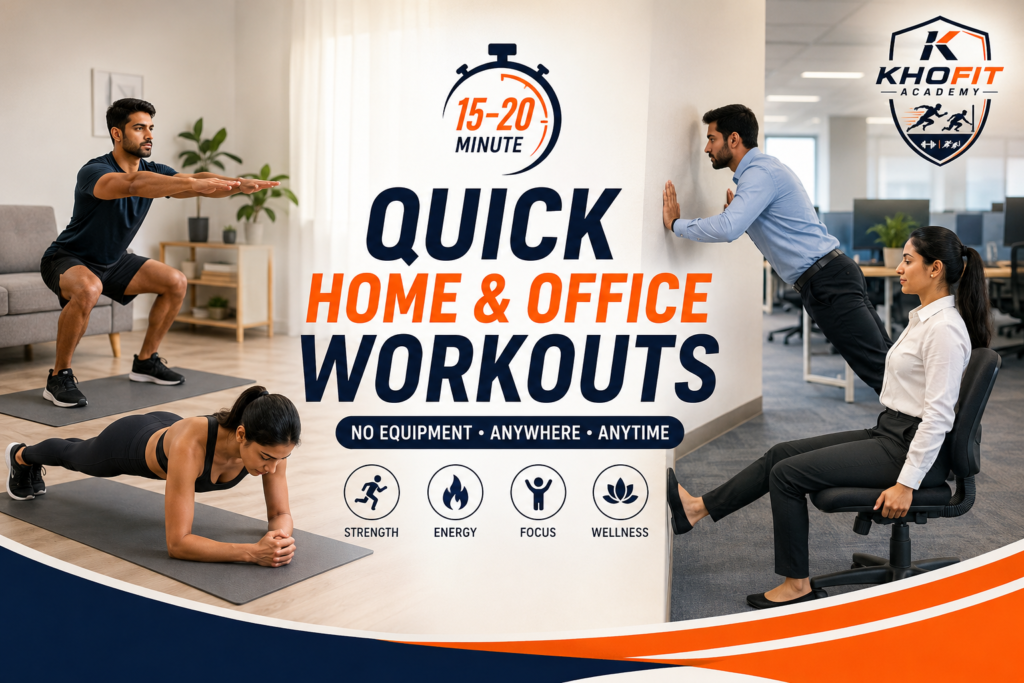
In this guide, you’ll discover:
- Why 15–20 minute workouts are effective
- Benefits of no equipment workouts
- The best home workout without equipment routines
- Office-friendly exercises you can do during work breaks
- Weekly workout plans for different goals
- Common mistakes to avoid
- A 7-day workout challenge to get started
Why 15–20 Minute Workouts Are Effective
Scientific Benefits of Short Workouts
Research shows that short bursts of exercise can provide substantial health benefits. Even a quick 15-minute workout at home can help:
- Improve cardiovascular health
- Increase calorie burn
- Boost metabolism
- Reduce stress and anxiety
- Improve mood through endorphin release
- Enhance overall fitness levels
The key is consistency rather than duration.
Time Efficient Fitness
Short workouts often use highly effective training methods such as:
High Intensity Interval Training (HIIT)
HIIT alternates between intense exercise and short recovery periods, helping maximize calorie burn in a short time.
Bodyweight Training
Bodyweight exercises use your own body as resistance, building strength and endurance without equipment.
Circuit Training
Circuit workouts combine multiple exercises performed back-to-back, keeping your heart rate elevated while targeting different muscle groups.
Improved Productivity
Exercise isn’t just good for your body it benefits your mind too.
Regular movement can:
- Improve concentration
- Enhance mental clarity
- Reduce workplace fatigue
- Increase creativity
- Improve decision making ability
For office workers and students, even a quick workout during a work break can improve performance throughout the day.
Consistency Beats Duration
Many people believe they need hour long workouts to see results.
The truth?
Fifteen minutes every day often delivers better long-term results than a single intense workout once a week.
Small daily habits create lasting fitness success.
Benefits of No-Equipment Workouts
Cost Savings
No gym membership.
No expensive machines.
No fitness gadgets.
A no equipment workout allows you to stay fit without spending money.
Accessibility
Bodyweight workouts can be done almost anywhere:
- At home
- In the office
- During travel
- In hotel rooms
- Outdoors
Your fitness routine stays consistent regardless of location.
Flexibility
You can easily adapt workouts based on:
- Available time
- Fitness level
- Energy level
- Space limitations
Whether you have 10, 15, or 20 minutes, there’s always time to move.
Functional Strength Development
Bodyweight exercises improve real world movement patterns and develop:
- Core stability
- Balance
- Mobility
- Coordination
- Functional strength
These benefits support everyday activities and reduce injury risk.
Best 15-Minute Home Workouts (No Equipment)
What Is the Best 15-Minute Workout at Home?
The best 15-minute home workout combines bodyweight exercises such as squats, push ups, lunges, planks, and jumping jacks. Performing these exercises in a circuit format keeps your heart rate elevated while improving strength, endurance, and overall fitness without requiring any equipment.
Beginner Full Body Workout
Perfect for those starting their fitness journey.
Exercises
| Exercise | Duration |
| Jumping Jacks | 30 Seconds |
| Bodyweight Squats | 30 Seconds |
| Knee Push-Ups | 30 Seconds |
| Glute Bridges | 30 Seconds |
| Plank Hold | 30 Seconds |
Workout Structure
- 30 seconds work
- 15 seconds rest
- Complete 3 rounds
Benefits
- Improves endurance
- Builds foundational strength
- Suitable for beginners
Fat Burning HIIT Workout
Want to maximize calorie burn?
Try this 15 minute HIIT session.
Exercises
- High Knees
- Mountain Climbers
- Squat Jumps
- Burpees
- Plank Jacks
Workout Structure
- 40 seconds work
- 20 seconds rest
- 3 rounds
Benefits
- Burns calories efficiently
- Improves cardiovascular fitness
- Increases metabolism
Core and Abs Workout
Strengthen your midsection with this focused routine.
Exercises
- Bicycle Crunches
- Leg Raises
- Russian Twists
- Plank
- Flutter Kicks
Structure
- 45 seconds work
- 15 seconds rest
- 3 rounds
Benefits
- Builds core strength
- Improves posture
- Enhances stability
Mobility and Flexibility Routine
Ideal for recovery days or reducing stiffness.
Exercises
- Arm Circles
- Hip Openers
- Cat-Cow Stretch
- World’s Greatest Stretch
- Child’s Pose
Benefits
- Improves mobility
- Reduces muscle tightness
- Enhances recovery
Best Office Workouts (No Equipment)
Can I Exercise at Work Without Equipment?
Yes. Many effective exercises can be performed in an office without equipment, including chair squats, desk push ups, calf raises, seated leg lifts, and standing stretches. These movements improve circulation, reduce stiffness, and help maintain energy levels throughout the workday.
Desk Friendly Workout
Exercises
- Chair Squats
- Seated Knee Raises
- Standing Calf Raises
- Wall Push-Ups
- Shoulder Rolls
Duration
Perform each exercise for 30–45 seconds.
Benefits
- Improves circulation
- Reduces prolonged sitting effects
- Increases energy
Stretch Break Routine
Long hours at a desk can create tension and stiffness.
Exercises
- Neck Stretch
- Wrist Stretch
- Chest Opener
- Hamstring Stretch
- Seated Spinal Twist
Benefits
- Improves posture
- Reduces neck pain
- Relieves back tension
Productivity Boost Circuit
Perform this routine every hour.
| Exercise | Reps/Duration |
| Squats | 20 |
| Desk Push-Ups | 15 |
| Walking | 30 Seconds |
| Stretching | 30 Seconds |
This simple routine helps maintain energy and focus throughout the workday.
Workout Plans for Different Goals
Weight Loss Plan
| Day | Activity |
| Monday | HIIT Workout |
| Tuesday | Walk + Mobility |
| Wednesday | HIIT Workout |
| Thursday | Walk |
| Friday | HIIT Workout |
| Saturday | HIIT Workout |
| Sunday | Recovery Walk |
Key Focus
- Calorie deficit
- Daily movement
- Consistency
Muscle Toning Plan
| Activity | Frequency |
| Strength Circuits | 4 Days |
| Core Workouts | 3 Days |
| Mobility Work | Daily |
Key Focus
- Controlled movements
- Progressive challenge
- Proper form
General Fitness Plan
| Activity | Frequency |
| Full-Body Workouts | 3 Days |
| Walking | Daily |
| Stretching | Daily |
Key Focus
- Overall health
- Sustainability
- Balanced fitness
Workplace Wellness Plan
| Activity | Frequency |
| Desk Exercises | Daily |
| Stretch Breaks | Every 2 Hours |
| Walking Breaks | 3–5 Times Daily |
Key Focus
- Reduced sedentary behavior
- Better posture
- Improved productivity
Common Mistakes to Avoid
Skipping Warm Ups
Warm muscles perform better and are less prone to injury.
Spend at least 2–3 minutes warming up.
Poor Exercise Form
Quality matters more than speed.
Focus on controlled, proper movement patterns.
Doing Too Much Too Soon
Start gradually.
Increase workout intensity as your fitness improves.
Inconsistent Scheduling
Treat workouts like appointments.
Schedule them in your calendar.
Ignoring Recovery
Recovery is where progress happens.
Prioritize:
- Sleep
- Hydration
- Rest days
- Stretching
Tips for Staying Consistent
Schedule Workouts Like Meetings
Block time on your calendar and treat it as non negotiable.
Use Habit Stacking
Attach your workout to an existing habit.
Examples:
- Exercise after morning coffee
- Stretch after lunch
- Walk after work
Track Your Progress
Use:
- Fitness apps
- Journals
- Habit trackers
Tracking creates motivation.
Set Realistic Goals
Focus on achievable milestones rather than perfection.
Find Accountability Partners
A friend, colleague, coach, or online community can help you stay consistent.
Celebrate Small Wins
Every completed workout matters.
Consistency builds confidence.
Sample 7 Day Workout Challenge
| Day | Workout |
| Day 1 | Beginner Full-Body Workout |
| Day 2 | Office Mobility Routine |
| Day 3 | Fat-Burning HIIT Workout |
| Day 4 | Stretch and Recovery |
| Day 5 | Core Workout |
| Day 6 | Full-Body Circuit |
| Day 7 | Active Recovery Walk |
Complete the challenge and evaluate your energy, mood, and productivity improvements.
Conclusion
Staying fit doesn’t require expensive equipment, a gym membership, or hours of free time.
A quick 15-minute workout at home can improve cardiovascular health, increase energy levels, boost productivity, and support long-term wellness goals.
Whether you’re a busy professional, remote worker, student, or beginner, no-equipment workouts offer a practical and effective way to stay active.
The secret isn’t finding more time.
It’s making the most of the time you already have.
Start with just 15 minutes today, and you’ll be surprised by the results consistency can create.
Ready to Get Started?
- Download our FREE 7-Day No-Equipment Workout Plan
- Subscribe for weekly fitness and wellness tips
- Book a consultation with a fitness coach
- Join our fitness challenge and stay accountable
Frequently Asked Questions
Is a 15 minute workout enough to stay fit?
Yes. Consistent 15 minute workouts can improve cardiovascular fitness, strength, endurance, and overall health when performed regularly.
Can I lose weight with 20 minute workouts?
Yes. When combined with a balanced diet and consistent activity, 20 minute workouts can support sustainable weight loss.
What is the best no equipment exercise?
Squats, push ups, lunges, planks, and burpees are among the most effective bodyweight exercises because they target multiple muscle groups.
How many calories does a 15 minute workout burn?
Depending on workout intensity and body weight, a 15 minute workout can burn approximately 100–250 calories.
Can beginners do no equipment workouts?
Absolutely. Most bodyweight exercises can be modified to match beginner fitness levels.
How often should I do home workouts?
Aim for at least 3–5 workout sessions per week, combined with daily movement, walking, and stretching for the best results.